One of the most common questions Twist N Turns receives from parents: “Which dance form should my child start with?” There is no single right answer — but there is a right answer for your specific child. This guide breaks it down honestly.
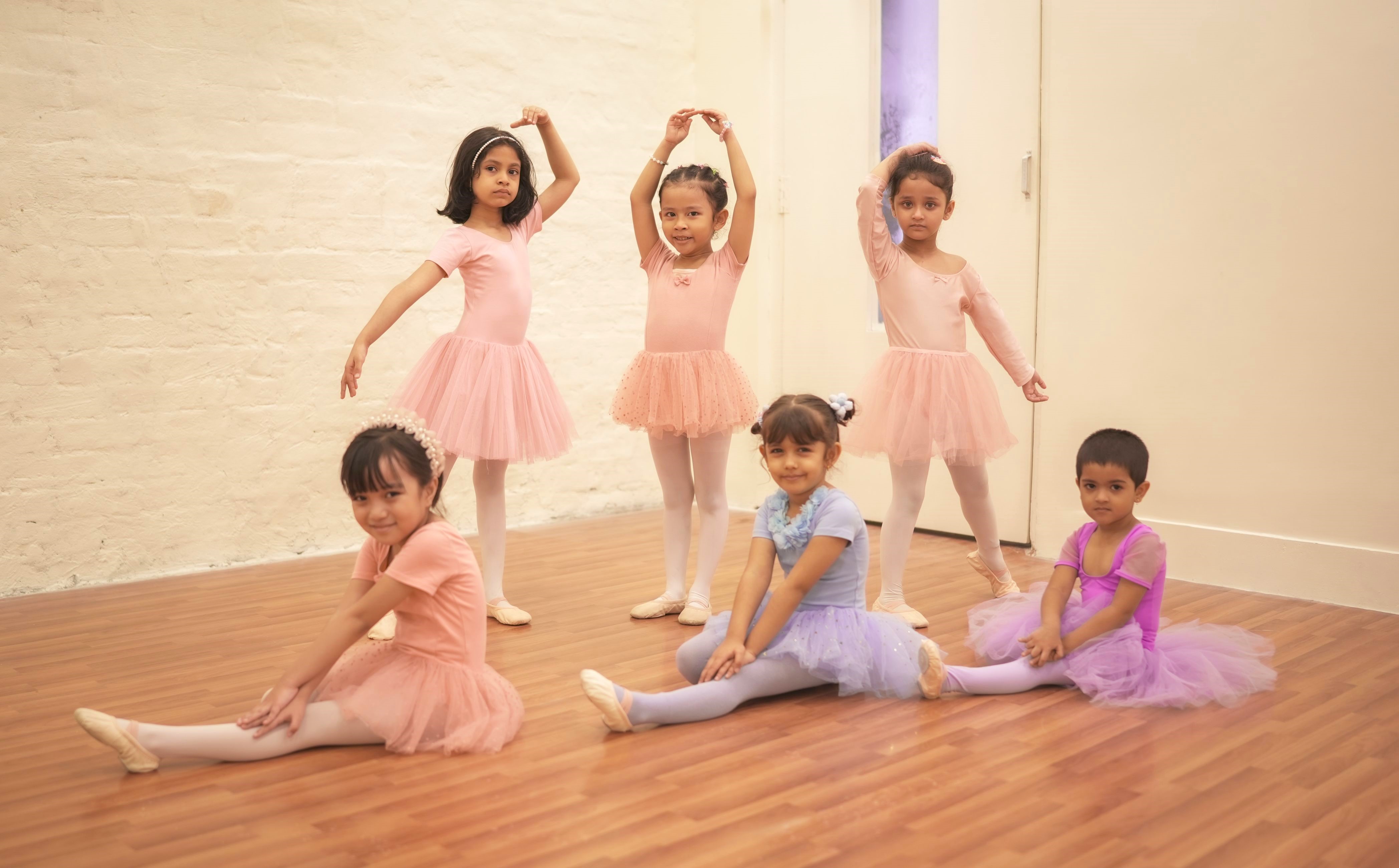
Walk into any Twist N Turns studio across Kolkata and you’ll see children doing remarkably different things in adjacent rooms. In one: a group of 7-year-olds in pale pink leotards learning to point their toes in a Ballet barre exercise. In the next: a batch of 10-year-olds in loose-fit clothes learning a Hip Hop phrase with a lot of attitude and laughter. Down the corridor: a Kathak class with bells on ankles and feet striking the floor in precise taal patterns.
Same age range. Very different experiences. And parents asking every day: which one is right for my child?
The honest answer is: all three are excellent, and the right choice depends on what your child responds to, what physical and artistic skills you want them to build, and what role dance is meant to play in their life. This guide gives you the information to make that call.
The Short Version — At a Glance
| Ballet | Kathak | Hip Hop | |
|---|---|---|---|
| Best starting age | 4–7 | 6–8 | 6+ |
| Physical demand | High (strength, flexibility) | High (footwork, stamina) | Moderate–High |
| Discipline required | Very high | Very high | Moderate |
| Cultural roots | Western European classical | North Indian classical | African-American urban |
| Examination structure | RAD / ISTD (international) | Prayag / Gandharva | None standard |
| Performance style | Classical recital / examinations | Recital / Arangetram-style | Competitions / shows |
| Typical fees (monthly) | ₹2,000–₹3,500 | ₹1,500–₹2,800 | ₹1,500–₹2,500 |
| Available at TNT? | ✅ All 8 studios | ✅ All 8 studios | ✅ All 8 studios |
Ballet — The Universal Foundation
What It Is
Ballet is a Western classical dance form with roots in 15th-century Italian court performance, codified in France and Russia over centuries into the highly structured technique recognised worldwide today. It is the foundation on which most professional Western dance styles — Jazz, Contemporary, Musical Theatre — are built.
What It Builds in Children
- Posture and alignment — Ballet corrects poor posture and builds a strong, upright carriage that benefits every other physical activity
- Core and leg strength — Barre work builds genuine functional strength that lasts into adulthood
- Turnout and flexibility — Developed gradually through proper training, not forced
- Musical intelligence — Ballet trains children to count music, feel phrasing, and move with the music rather than to it
- Discipline and patience — Progress in Ballet is measured in years, not months. Children learn that consistent effort over time produces results — a mindset that transfers far beyond the studio
The Examination Structure
Ballet taught under the Royal Academy of Dance (RAD) or ISTD (Imperial Society of Teachers of Dancing, UK) syllabi leads to internationally recognised graded examinations. These grades — Pre-Primary through Grade 8 and Advanced — are taken every 12–18 months and carry genuine weight if your child pursues dance seriously later.
Twist N Turns is the only institute in Kolkata teaching Jazz under the ISTD syllabus. Our Ballet teaching follows structured graded curriculum aligned to recognised examination boards.
What Parents Often Don’t Expect
Ballet is slow to reward impatience. The first six months of Ballet class look like a lot of standing at the barre doing repetitive exercises. There’s no big routine to show family at Diwali yet. Parents who pull their child out because “they’re not doing anything interesting yet” are quitting precisely at the point where the foundation is being laid. Stick through the first year.
Best For
Children who: enjoy structure and measured progress, are willing to practise between classes, have parents who understand that the payoff is long-term, want international examination credentials, or have aspirations toward professional dance or dance-related performance careers.
Kathak — Rhythm, Storytelling, and Cultural Identity
What It Is
Kathak is one of India’s eight classical dance forms, with origins in North Indian devotional traditions and refinement in the royal courts of Lucknow and Jaipur. The word itself comes from katha — story — and the form is built around three elements: nritta (pure rhythmic movement), nritya (expressive storytelling), and natya (dramatic enactment).
It is recognised and supported by the Sangeet Natak Akademi — India’s highest body for the performing arts — and is taught in conservatories from New Delhi to London.
What It Builds in Children
- Rhythmic intelligence — Kathak training is inseparable from taal (rhythm cycles). Children who study Kathak develop a precise internal clock and the ability to count complex rhythmic patterns that most adults cannot
- Footwork and stamina — Tattkar (footwork sequences) are physically demanding and build exceptional lower body strength and coordination
- Expressive range — Abhinaya (expression) teaches children to use face, eyes, hands, and body to tell stories — a skill that builds emotional intelligence and performance presence
- Cultural connection — For children growing up in India, Kathak is a direct link to one of the subcontinent’s most sophisticated artistic traditions. It has genuine cultural weight that Hip Hop and Ballet do not carry in the same way in an Indian context
The Examination Structure
Kathak graded examinations are offered through bodies including Prayag Sangeet Samiti and Gandharva Mahavidyalaya. The highest level — Visharad — is equivalent to an undergraduate qualification in the performing arts and is recognised by some universities. The Arangetram is the formal public debut recital that marks the end of foundational training, typically after 7–10 years of consistent study.
What Parents Often Don’t Expect
Kathak is substantially more physically demanding than it looks on stage. The seated position (half-squat, knees turned out) used during some teaching is hard on the knees if maintained incorrectly. Proper instruction matters enormously. The footwork — striking the floor precisely with weighted ghungroos (ankle bells) — is also surprisingly tiring for young beginners. Expect the first 3 months to feel slow.
Best For
Children who: are drawn to Indian music and cultural tradition, enjoy storytelling and expressive performance, want a connection to a structured classical art form rooted in Indian identity, or have parents who value classical training and are willing to commit to the multi-year arc.
Hip Hop — Rhythm, Groove, and Confidence
What It Is
Hip Hop is not a single technique but a broad culture of movement that emerged from African-American communities in New York in the early 1970s. The major styles within the broad “hip hop” umbrella include breaking (b-boying/b-girling), popping, locking, house, and new style/jazz-funk. What’s taught in most Indian children’s dance studios is primarily new-style Hip Hop and freestyle movement, often blended with elements of jazz.
What It Builds in Children
- Groove and rhythm — Hip Hop trains the body to find the beat instinctively rather than counting consciously. Students develop a natural musicality that’s different from — and complementary to — the trained musicality of Ballet
- Freestyle confidence — Unlike classical forms, Hip Hop rewards individual expression. Children who struggle with the perfectionism of Ballet or Kathak often discover a completely different relationship with movement through Hip Hop
- Performance energy — Hip Hop is made for the stage in a visceral, crowd-engaging way. Students develop stage presence quickly
- Peer connection — Hip Hop class culture is generally social, collaborative, and fun. It’s often the style that shy or physically uncertain children warm to first
What Parents Often Don’t Expect
Not all “Hip Hop” classes are equivalent. Some teach genuine urban dance vocabulary. Others teach choreographed Bollywood-adjacent movement labelled as Hip Hop because it’s more marketable. Ask to watch a class — or at minimum ask the instructor what specific styles they cover and what their training background is.
Hip Hop without a graded examination structure means progress is harder to measure externally. Competitions (reality TV-style, local, and national) exist and are a meaningful goal-setting mechanism for children who need external milestones.
Best For
Children who: are energetic and rhythm-driven, prefer social and collaborative learning over individual technical drilling, want to perform in shows and competitions, have a more free-spirited temperament, or are starting dance older (10+) and want to experience quick wins before committing to a classical discipline.
What About Combining Styles?
Many Twist N Turns students do exactly this — and often thrive because of it.
The combinations that work best:
Ballet + Hip Hop — Ballet builds the physical architecture; Hip Hop fills it with personality. Many of Kolkata’s most versatile young dancers train in both. The styles are far more compatible than they appear.
Kathak + Contemporary — Kathak’s precise footwork and expressive vocabulary complement Contemporary’s emphasis on weight, fall, and spatial exploration. Students who study both typically develop exceptional stage presence.
Ballet + Kathak — Rarer but rewarding. Both require deep physical discipline. Students who sustain both gain an extraordinary range of physical vocabulary and examination credentials.
The practical constraint is time. Two serious style commitments means at minimum 3–4 classes per week, which only suits students with supportive schedules and genuine passion for the art form.
A Decision Framework for Parents
Answer these three questions:
1. What does your child respond to when they watch dance? Attend a performance or watch dance videos together. What makes them want to move — a Ballet recital, a Kathak performance, or a Hip Hop video? Their instinctive response is a reliable signal.
2. What role do you want dance to play in their life? Hobby and fitness? Any style works. Cultural identity and classical training? Kathak or Bharatanatyam. International examination credentials? Ballet or ISTD Jazz. Performance and competition? Hip Hop or Jazz.
3. What’s your family’s commitment horizon? Classical styles (Ballet, Kathak, Bharatanatyam) require 3–5 year commitments to deliver their real value. If you know the schedule or appetite might not sustain that, a style with shorter feedback loops (Hip Hop, Bollywood, Zumba) may produce more satisfaction.
Try Before You Decide
The most reliable way to know which style fits your child is to try a class in each one before committing fees. Children often have viscerally clear reactions within 20 minutes of their first class.
Twist N Turns offers free trial classes at all 8 studios across Kolkata — Salt Lake, Ballygunge, Dum Dum Park, Ruby, New Alipore, New Town AA1, Rajarhat–New Town AA2, and Madhyamgram.
📞 Call or WhatsApp: 98310 18015
🌐 Book online: twistnturns.in/free-trial.html
✉️ Email: info@twistnturns.in
No deposit. No obligation. Just show up and dance.