When Technique Meets Expression
Jazz gives you the spine. Contemporary fills it with a soul.
These two dance forms are taught together at Twist N Turns for a reason — they are, in many ways, each other’s answer. Jazz builds the technical architecture that a dancer lives inside: the posture, the precision, the clean execution of turns and leaps. Contemporary hands the dancer the freedom to inhabit that architecture expressively, to move through it with personal intention and artistic depth.
If you have been searching for Jazz and Contemporary dance classes in Kolkata that offer more than surface choreography, you are in the right place. Twist N Turns is the only studio in Kolkata teaching Jazz and Contemporary dance under the ISTD (Imperial Society of Teachers of Dancing) syllabus — with classes running at Salt Lake, Dum Dum Park, Ruby, and New Alipore.
What Is Jazz Dance?
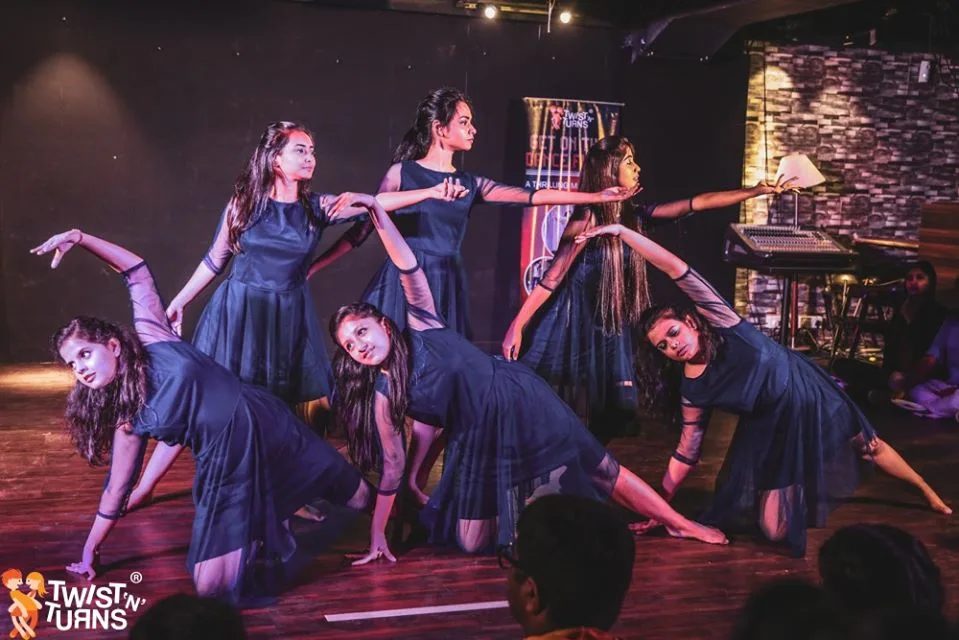
Jazz dance is a western semi-classical form — technically demanding, rhythmically driven, and unmistakably theatrical when it is done well. It emerged from African-American vernacular dance traditions in the early twentieth century and developed into one of the most technically rigorous social and performance dance forms in the world.
What distinguishes Jazz from other dance forms is the primacy of technique in shaping style. A Jazz dancer must first build the physical vocabulary — correct posture and alignment, controlled turns, powerful leaps, and a strong core — before any of the stylistic elements can be executed with integrity. Jazz without technique is movement without language.
The styles within Jazz reflect its broad expressive range:
- Latin Jazz — percussive, sharp, and grounded in Afro-Latin rhythmic traditions; demands precision in weight transfer and footwork
- Lyrical Jazz — fluid, emotive, and drawn towards the texture of music rather than its beat; bridges Jazz technique with expressive depth
- Broadway Jazz — theatrical, expansive, and built for the stage; the Jazz of musical theatre, grand in gesture and alive with personality
- Power Jazz — athletic and high-energy; characterised by explosive jumps, dynamic turns, and the kind of physical commitment that demands serious conditioning
- Modern Jazz — the contemporary descendant of classic Jazz technique; absorbs influences from Hip Hop, Contemporary, and other forms while keeping a structured technical core
Training across these sub-styles develops a dancer who is technically fluent and stylistically versatile — capable of moving between genres without losing precision.
What Is Contemporary Dance?
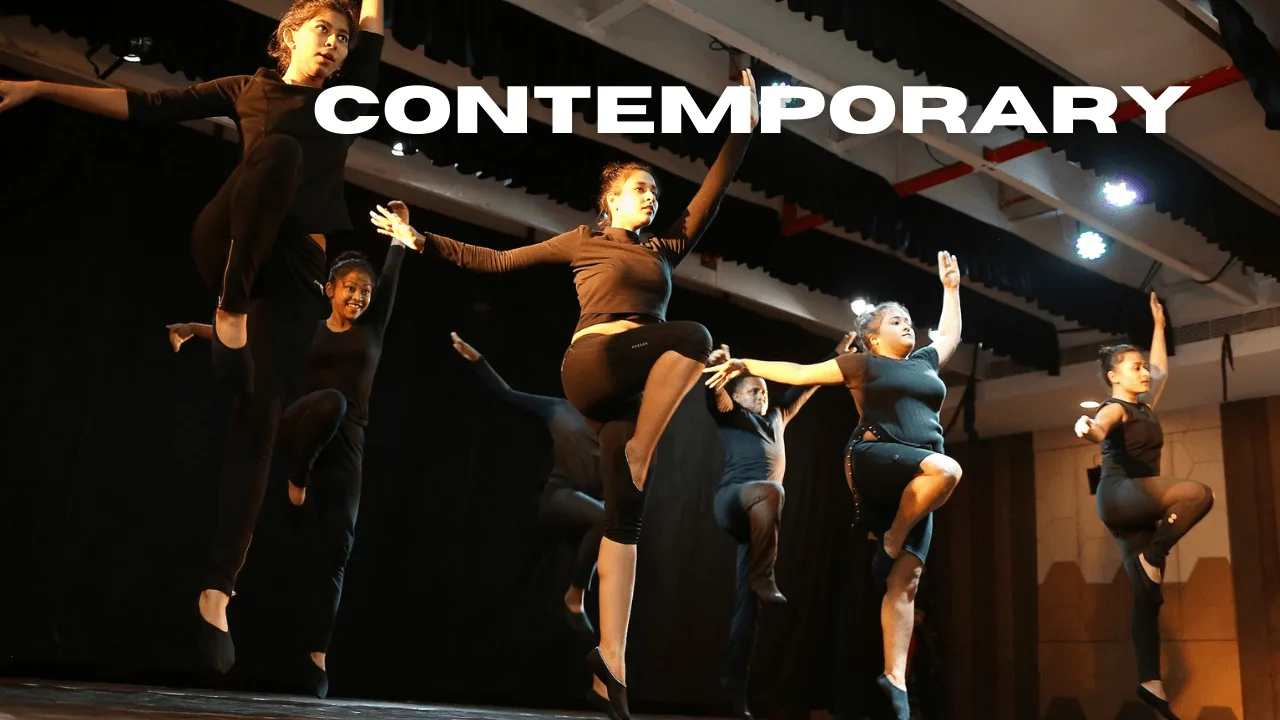
Contemporary dance is, in the most literal sense, a dance of its time — always absorbing, always evolving, always in dialogue with what is happening in the wider world of movement. It emerged in the early twentieth century as a direct response to the rigidity of classical Ballet, and grew into a form that incorporates Ballet, Jazz, Modern, and improvisation-based movement into a fluid, personally expressive whole.
In practice, contemporary dancers work with a set of principles rather than a fixed vocabulary:
- Floor work — contemporary dancers spend significant time on the ground, using gravity as a resource rather than fighting it; rolls, spirals, and level changes become expressive tools
- Improvisation — structured freedom is built into training; dancers learn to generate and respond to movement in real time, developing a personal movement vocabulary
- Emotional storytelling — the body becomes a narrative instrument; movement is motivated by intention, not just musicality
- Spatial and dynamic range — from sweeping, large-scale phrases to near-stillness, the dynamic range in contemporary is wider than in almost any other form
- Full-body integration — every part of the body is active and purposeful; nothing is merely decorative
Contemporary dance is not the absence of technique. It is technique applied with freedom.
Jazz and Contemporary Together — Why the Combination Works
Teaching Jazz and Contemporary as a combined programme is a deliberate choice at Twist N Turns, and it reflects the way these forms have always evolved in relationship to each other.
Jazz provides the technical infrastructure that makes Contemporary expressive rather than vague. Without the posture, the core strength, and the precision that Jazz demands, contemporary movement often collapses into gesture without intention. With it, every choice — a tilt of the head, a fall into the floor, a turn that slows before it resolves — carries weight.
Contemporary, in turn, gives Jazz dancers something to say. The technique becomes a vessel rather than an end in itself. Students who train in both consistently describe a moment when the movement stops being about execution and starts being about expression. That is the combination working.
What You Learn in Class
Body Conditioning and Alignment
Before any choreography, we build the body. Each class begins with 20 minutes of conditioning — stretching, cardio, toning, and core strength. This is not a formality. Jazz demands physical resilience: the ability to execute turns and leaps cleanly requires muscular preparation that takes months to develop. Contemporary demands suppleness and body awareness that conditioning builds systematically.
Technique and Dance Routine
The second 20 minutes focuses on technique and a structured dance routine. At the Jazz end, this means postural alignment, turn sequences, jump preparation, and style work across the sub-forms. At the Contemporary end, it means floor sequences, level changes, dynamic phrasing, and the use of improvisation as a compositional tool.
Choreography
The final 20 minutes puts technique to work. Students learn choreographed sequences that integrate what they have built in conditioning and technique. This is also where sub-style work happens — a session focused on Lyrical Jazz will produce very different choreography from one focused on Power Jazz. Both are building toward the same technical foundation.
ISTD Graded Progression
All training at Twist N Turns follows the ISTD syllabus — a structured, internationally recognised progression system. Students move through clearly defined grades, with examinations conducted by qualified examiners. This is a significant differentiator from most dance studios in Kolkata, which teach to no external standard. The ISTD grades ensure that students are genuinely progressing — and that their progress is measurable and globally recognised.
The Benefits of Jazz and Contemporary Training
Physical Benefits
Jazz is one of the most physically demanding dance forms. The combination of conditioning, precision technique, and dynamic choreography builds genuine athletic capacity — muscular strength (particularly in the core, legs, and back), flexibility, coordination, and postural control. Students who train seriously in Jazz typically see visible changes in how they carry themselves within a few months.
Contemporary training adds a complementary physical dimension: deep spinal mobility, hip flexibility, and the kind of body awareness that comes from learning to use the floor, manage weight transfer, and vary dynamic quality systematically.
Artistic Benefits
Jazz trains musicality in a specific way: not just following a beat, but understanding how rhythm, phrasing, and accent work in music and translate into movement. The crisp execution that Jazz demands teaches a dancer to value precision — and to hear when a performance is slightly off, whether in themselves or others. This sharpens artistic judgement across every dance form.
Contemporary deepens expressive range. It asks dancers to mean something with every gesture — not to perform emotion from the outside, but to generate it from genuine physical commitment. Students who train in Contemporary consistently develop a quality of presence on stage that other training rarely produces.
Cross-Training Benefits
For students already studying Ballet, Hip Hop, Bollywood, or Salsa: Jazz and Contemporary training is the most productive cross-training investment you can make. Jazz technique strengthens everything that requires precision and control. Contemporary opens the expressive dimension that makes any performance style more alive. Dancers who train across forms consistently outperform single-discipline peers in auditions and on stage.
Who Is This Class For?
Teenagers (13–17)
Jazz and Contemporary is particularly well-suited to teenagers. The technical rigour of Jazz satisfies the hunger for real, measurable progress — students can feel themselves getting stronger, turning better, jumping higher. The expressive depth of Contemporary gives an outlet for the artistic energy that teenagers bring to the studio. Many of our teenage students describe Jazz and Contemporary as the class where they feel most themselves as dancers.
Adults
Adult beginners and experienced dancers both thrive in Jazz and Contemporary. The ISTD structure means there is always a defined next level to work toward, which keeps training purposeful. Adults often progress faster than they expect — the focus and emotional maturity they bring to the studio accelerates learning in ways that are less available to younger students.
For adults exploring dance seriously for the first time, Jazz and Contemporary offers something relatively rare: a Western technique-grounded form where progress is structured, examinable, and internationally recognised.
Why Twist N Turns for Jazz and Contemporary in Kolkata
ISTD syllabus. We are the only studio in Kolkata teaching Jazz and Contemporary dance to an internationally recognised standard. The ISTD framework ensures that our students are building real technique, not just learning choreography, and that their progress is measurable at each grade.
Experienced instructors. Our Jazz and Contemporary faculty have trained extensively in the form — many hold ISTD qualifications themselves. They bring technical precision and genuine artistic sensibility to every session.
Performance opportunities. Training at Twist N Turns does not stay in the studio. Students perform at our annual concerts and seasonal showcases — gaining real stage experience and the chance to see how their technique holds under performance conditions. These experiences are formative for any serious dancer.
Combined programme design. Teaching Jazz and Contemporary together, in a single structured curriculum, is not standard practice in Kolkata. It reflects a pedagogical view we have held since our founding — that the two forms develop each other, and that separating them produces narrower dancers.
Small batch sizes. We keep batches deliberately small. In Jazz and Contemporary particularly, where individual feedback on technical precision and expressive quality matters enormously, personal attention is non-negotiable.
If you are specifically interested in Contemporary as a standalone form, explore our dedicated Contemporary Dance Classes in Kolkata page. For those interested in Western classical foundations, our Ballet classes provide the underlying alignment training that makes Jazz technique easier to build.
Class Schedule
Current batch timings are shown below, pulled live from our studio sheet. Call or WhatsApp 9831018015 to confirm availability before joining.
Frequently Asked Questions
What makes Jazz and Contemporary classes at Twist N Turns unique in Kolkata?
Twist N Turns is the only studio in Kolkata teaching Jazz and Contemporary dance under the ISTD (Imperial Society of Teachers of Dancing) syllabus — the same internationally recognised framework used by dance schools across the UK. This gives students a structured, graded pathway rather than informal choreography-only training.
How long does it take to complete the Jazz and Contemporary course?
The basic course takes approximately 2 years to complete. Jazz technique requires patience — rushing through foundational stages produces a dancer who looks right but moves wrong. We encourage every student to allow the technique to settle before moving to the next level.
What Jazz styles are taught at Twist N Turns?
The curriculum covers Latin Jazz, Lyrical Jazz, Broadway Jazz, Power Jazz, and Modern Jazz. Each sub-style has a distinct flavour — Latin Jazz is percussive and sharp, Lyrical Jazz is fluid and emotive, Broadway Jazz is theatrical and expansive. The technical foundation we build applies across all of them.
What is the difference between Jazz and Contemporary dance?
Jazz is a structured semi-classical western form built on a defined technical vocabulary — posture, turns, leaps, and footwork. Contemporary dance is a more exploratory, evolving form that blends Ballet, Jazz, and Modern influences to express ideas that feel present and personal to the dancer. In our combined class, students develop both the structure and the freedom.
What is the class structure for Jazz and Contemporary?
Each class runs for 1 hour: 20 minutes of body conditioning (stretching, cardio, toning, and core strength), 20 minutes of technique and dance routine, and 20 minutes of choreography. The structure is deliberate — conditioning first ensures the body is ready, technique builds the vocabulary, and choreography puts it to use.
Do I need prior dance experience to join Jazz and Contemporary classes?
Not necessarily. Beginners are welcome, though some prior exposure to Ballet or a structured dance form helps. Our instructors assess each new student during their first session and place them in the right batch.
Where are Jazz and Contemporary classes held in Kolkata?
Jazz and Contemporary classes run across multiple Twist N Turns studios in Kolkata. Current batch timings are shown in the schedule table on this page — updated automatically from our studio sheet. Call or WhatsApp 9831018015 to confirm availability and book your first session.
Do students receive a certificate after completing the course?
Yes. A certificate is awarded on the basis of an internal examination conducted after course completion. To be eligible, students must attend a minimum of 39 classes. 80% attendance throughout the course is mandatory — this ensures the technical depth needed to pass the examination.
Is Jazz dance good for a dance career?
Jazz is considered an essential technical foundation for a professional dance career. Its emphasis on posture, turns, leaps, and core strength gives dancers a versatility that translates across styles — from stage performance to choreography to teaching. Many of our students who pursue dance professionally cite Jazz training as the most valuable part of their foundation.
Can teenagers join Jazz and Contemporary classes at Twist N Turns?
Absolutely. Jazz and Contemporary is particularly well-suited to teenagers — the technical rigour satisfies the hunger for real progress, while the expressive depth of Contemporary gives an outlet for the artistic energy that teenagers bring to the studio. We have dedicated teenage batches at multiple locations.
Start Training — Book Your Free Trial
Jazz and Contemporary dance in Kolkata, taught to an international standard. Whether you are a teenager ready to build a real technical foundation, or an adult who wants to move with genuine depth and precision — our classes are structured for you.
ISTD syllabus. Experienced instructors. Small batches. Real performance opportunities.
Speak to us directly: call or WhatsApp 9831018015, or email info@twistnturns.in. We will find the right batch for you.
Current Class Schedule
Current schedule for this class is being updated. Call or WhatsApp 9831018015 for today's available batches.