Easy Sangeet Dance Steps to ‘Raina’ (Arijit’s #1 Reel Hit of 2026)
If you have opened Instagram in 2026, you have seen it — that unmistakable opening piano note, a hand reaching out toward the camera, a slow sway that pulls you in before the chorus even arrives. Arijit Singh’s “Raina,” released on 1 March 2026, became a Reels phenomenon within days of dropping, and it shows no sign of slowing down. What makes it so shareable is not just the song — it is the fact that the choreography practically writes itself. The melody’s gentle pulse gives dancers just enough time to hit every move cleanly, and the emotional swell of the chorus turns even a simple step into something that looks intentional, heartfelt, and completely cinematic at 9:16.
This guide breaks the Raina choreography down into an easy 8-count foundation, four progressive variations (from grandmom-safe to couples showstopper), and practical filming advice so your Reel actually looks as good as it felt. Whether you are planning a Sangeet performance or just want your next post to stop the scroll, this is your starting point.
Why “Raina” Is the Dance Song of 2026
Three things separate a viral dance song from one that simply gets played a lot. First, the tempo has to be forgiving — fast enough to feel energetic on screen, slow enough that a non-professional dancer can hit their marks cleanly. Raina sits at approximately 78 BPM, which is the sweet spot for expressive upper-body movement without demanding footwork precision.
Second, the song has to have a recognisable hook that viewers identify within two seconds of watching a Reel. Raina’s opening piano line does exactly that — it is the kind of melody that makes someone stop mid-scroll because their brain immediately files it under “I know this feeling.”
Third, and most relevant for Sangeet choreography, the song has emotional architecture. It builds. There is a quiet, intimate opening section, a swelling second verse, and a chorus that asks for your full presence. That structure gives choreographers — and DIY dancers — three distinct emotional gears to shift through, which is what separates a memorable Sangeet performance from a technically adequate one.
For wedding families in Kolkata planning their 2026 Sangeet season, Raina is also a practical choice: it fits the “love-story ballad” trend that has dominated wedding choreography requests since late 2025, and it works equally well as a standalone number or as the emotional anchor of a longer medley.
The 8-Count Foundation — Learn This First
Everything in this guide builds on a single repeatable 8-count. Master this, and all four variation levels become straightforward additions rather than new things to learn.
Starting position: Stand with your feet hip-width apart, weight centred, arms relaxed at your sides. If you are filming, position yourself so the camera sees you from roughly mid-chest to top of head — this is the Reel-optimised crop zone where all the hand and face work reads clearly.
Counts 1–2: The Draw Shift your weight gently onto your right foot. As you do, bring your right hand up slowly — palm facing inward, fingers soft — until it reaches chest height. Your gaze follows the hand. Think of it as reaching toward someone just out of frame. This is the signature opening gesture of the Raina choreography and the image that hooks viewers in the first second of your Reel.
Counts 3–4: The Settle Let the hand drift back down, elbow leading, as your weight transfers to centre. On count 4, add a subtle hip drop to the left — not a sharp pop, just a quiet acknowledgement of the beat. Keep your shoulders relaxed and your chin level. The temptation is to look down at your feet; resist it. Eyes forward or slightly upward reads ten times better on camera.
Counts 5–6: The Mirror Draw Repeat the Draw on the opposite side. Left weight shift, left hand rises to chest height, gaze follows. The rhythm is the same but the body’s bilateral movement creates the visual call-and-response that makes this sequence feel complete rather than one-sided.
Counts 7–8: The Close Both hands come together at chest centre — not clasped, but fingertips nearly touching, as though cradling something fragile. Hold for count 8. This closing gesture is your transition point; from here the sequence loops back to count 1 seamlessly, or you step into whichever variation level you are performing.
Practise tip: Run through the 8-count without music three times, counting aloud. Then put the song on and start at the second verse (approximately 1 minute in) where the tempo is clearly established. Do not start at the very beginning — the opening piano is slower and can confuse your timing on first attempts.
4 Variations — Easy to Advanced
Level 1 — Stationary (Grandmom-Safe)
This version keeps your feet planted throughout. It is ideal for participants who want to join the Sangeet performance without worrying about footwork, for anyone dancing in a tight saree or heavily embroidered lehenga, and for Reels filmed from a fixed phone propped against a wall.
Perform the full 8-count foundation exactly as described above. On counts 1–4 of the repeat, add a gentle head tilt in the direction of the raised hand — just 10 to 15 degrees, no more. This small addition transforms the sequence from “movement exercise” into “emotional moment” on camera.
For group Sangeet use, this level works well for older family members positioned at the sides of the formation, where upper-body synchrony with the central dancers creates a visually unified frame without asking anyone to travel across the stage.
Level 2 — Traveling (Typical Reel Dancer)
Level 2 introduces a simple side-step that gives the choreography forward momentum — the quality that makes a Reel feel like a performance rather than a pose.
In counts 1–2, step your right foot out to the right as your right hand draws upward. Your body weight shifts with the step rather than in place. Counts 3–4, close your left foot to meet the right as the hand settles. Counts 5–6, step left and draw left. Counts 7–8, close right and bring hands to centre.
You are now traveling six to eight inches in each direction per cycle. On a phone screen at 9:16, this lateral movement adds life without taking you out of frame. For Sangeet on stage, this level gives the audience the sense that the dancer is inhabiting the full space rather than standing still.
The key technique note here: keep your sway in the hips, not in the knees. When the weight shifts with the step, let it register in your hip first. Knee-led stepping looks mechanical; hip-led stepping looks like dancing.
Level 3 — Spins and Hip Isolations (Intermediate)
At Level 3, you add two embellishments that significantly elevate the visual impact of the choreography: a single spot turn and a hip isolation on the close.
In the first cycle (counts 1–4), perform the Level 2 traveling step as normal. In the second cycle (counts 5–8 of the repeat), on count 5 as you step left, initiate a single spot turn to the left — one full rotation, stepping through on counts 5 and 6, landing back in starting position on count 7. On count 8 at the close, add a sharp hip accent to the left: a clean, isolated pop that punctuates the closing gesture.
For Reels, the turn is the moment viewers rewind to watch again — it is the technical proof that you know what you are doing, even if everything else in the sequence is accessible. Film the turn from slightly below eye level (phone propped on a low surface or a low-angle selfie stick) and it will look effortlessly elegant.
For Sangeet, teach the turn only to confident participants. Have others in the group hold the Level 2 sway on those same counts — the mix of movement levels across the group actually reads as intentional choreographic layering rather than inconsistency.
Level 4 — The Hero Moment (Couples)
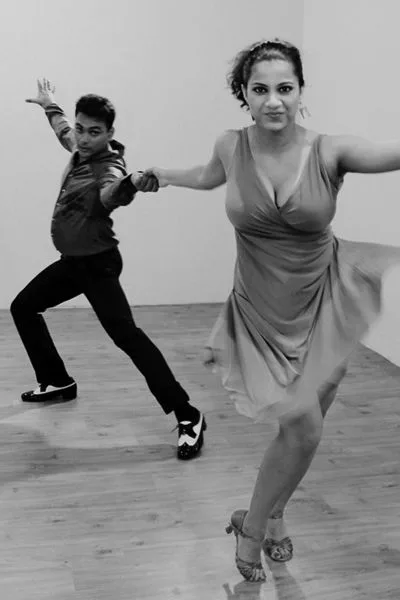
Level 4 is built for the emotional peak of the song — the second chorus, approximately 2 minutes 20 seconds in, where Arijit’s voice fully opens up. This is where the couple has their defining stage moment.
The setup: partners face each other, right hands joined at chest height (mirroring the single-dancer Draw gesture, now shared). Left hands rest lightly on each other’s left shoulder. For counts 1–6, both partners perform the head-tilt and gentle sway in unison — a slow, synchronised acknowledgement of each other.
On count 7, the lead partner steps forward into the frame as the other partner steps back, creating a natural, unforced dip shape. The dipping partner’s free left hand extends outward and slightly downward — not dramatically, just enough to open the silhouette. Hold through count 8.
This is not a theatrical lift. It is a lean and extend — fully achievable with zero partner-acrobatics experience, completely safe in wedding outfits, and visually stunning on both a phone screen and a Sangeet stage because it creates a clear, still shape at the song’s emotional apex.
For Reels, film the dip from the front at a slight angle — a straight-on shot flattens the shape; a 30-degree offset shows the depth and makes the moment three-dimensional.
Why “Raina” Works for Sangeet
The 2026 wedding season in Kolkata has seen a clear shift in Sangeet choreography requests: couples and families are moving away from high-energy mash-ups as the only format and actively seeking songs that let them express something more personal on stage. Raina sits at the centre of that shift.
Its lyrical content — a song about being someone’s shelter, someone’s home — resonates with the emotional intent of a Sangeet performance in a way that a purely energetic number cannot replicate. The audience at a Sangeet already knows the couple’s love story; a song that mirrors that story creates an immediate, wordless connection between the performers and the room.
At 3 minutes 50 seconds, Raina is also the ideal length for a Sangeet medley anchor. A typical family Sangeet medley runs 8–12 minutes. Raina takes up roughly a third of that time, leaving room for an upbeat opener and a celebratory closer without the medley feeling padded. Our choreographers at Twist N Turns have found that placing Raina as the second piece in a three-song structure — after the energy of the opening number has warmed up the audience — consistently produces the strongest audience response.
For families who want to incorporate multiple generations, the four variation levels in this guide create a natural casting framework: grandparents and young children perform Level 1 at the edges of the formation, cousins and siblings perform Level 2 in the mid-layer, and the bride, groom, or closest friends perform Levels 3 and 4 at the centre.
Filming Tips — Make Your Raina Reel Look as Good as It Feels
Frame from mid-chest up. The Raina choreography is upper-body and face dominant. A full-body frame on a phone screen makes every gesture half the visual size it needs to be. Position the camera at your sternum height and frame so the top of your head has two to three centimetres of clearance.
Use natural window light, not a ring light. Ring lights create a flat, “content creator setup” look that undercuts the intimate quality Raina requires. Position yourself facing a large window with soft daylight — it adds dimension and makes fabric move beautifully.
Shoot in a clean, uncluttered background. A white wall, a softly blurred indoor setting, or fabric draped loosely behind you. Avoid busy room backgrounds or ceiling fans in shot.
Record at 1x, not zoomed. Camera zoom on a phone degrades video quality visibly after Instagram’s compression. Move your body or your phone stand; never use digital zoom.
Film three takes minimum, pick the best. Set your phone on a stable surface, start the song, hit record, and go. Three takes takes under five minutes and gives you options. The best Raina Reels are not technically perfect — they are the ones where the performer looks like they mean it, which usually happens on take two or three.
Learn with Twist N Turns
If you want to move faster — or you need the choreography adapted for a specific family group, stage size, or medley concept — we at Twist N Turns are here for exactly that.
Our choreographers work with Sangeet groups of all sizes, across all seven of our Kolkata studios, and we regularly run group sessions designed specifically for wedding choreography planning. Whether you need a polished 4-minute couple’s routine, a full family Sangeet medley, or just 15 minutes with a trained instructor to get your Reel-ready foundation locked in, we can make it happen.
Book a free trial class at any of our seven studios — or reach out at info@twistnturns.in or call us at 9831018015. You can also explore our Sangeet and wedding choreography services or browse our full range of dance classes and programmes.
What Is Coming Next
A full step-by-step video tutorial for this choreography — filmed in studio by our Twist N Turns team — is in production and will be available soon. The video will walk through all four variation levels with on-screen count cues, multiple camera angles for the spin and dip moments, and a full run-through at performance tempo. Follow us on Instagram and YouTube so you catch it the moment it drops.
Frequently Asked Questions
Can I learn the Raina dance steps in one day? Yes — and that is exactly what this guide is built for. The Level 1 and Level 2 versions are designed to be picked up in 5–10 minutes of focused practice. Most people who follow this 8-count breakdown can post their first Reel the same day.
Is Raina a good song for a couples dance at Sangeet? Absolutely. The slow-build melody gives couples time to connect on stage, the emotional peak creates a natural hero moment for a dip or freeze, and the 3–4 minute length fits perfectly into a Sangeet medley.
Should I use the original Raina or a Sangeet remix? For Reels, use the original — the trending audio gives your post an algorithm boost. For a stage performance, a subtle dhol-and-strings remix adds energy while keeping the vocal recognisable.
Can I mix Raina with other songs in a Sangeet medley? Yes. Raina works beautifully as the emotional anchor of a three-song medley — upbeat opener, Raina in the middle, celebratory closer. Our choreographers design full Sangeet medleys using exactly this structure.
Do I need dance experience to learn these steps? None at all. Level 1 requires only basic side-to-side stepping; Level 2 adds a walking rhythm most people already do instinctively. The advanced variations build on the same foundational 8-count.
How long is the Raina song? Approximately 3 minutes 50 seconds — ideal for a Sangeet solo or duet. Long enough to build an emotional arc, short enough to hold audience attention without fatigue.
What outfit works best for the Raina Reel look? Soft, flowing fabrics — georgette, chiffon, or a sheer dupatta — read beautifully during the sway sections. Warm jewel tones (deep red, emerald, royal blue) photograph well under event lighting. Avoid very stiff fabrics for Level 3 and Level 4 steps.
Can Twist N Turns choreograph a custom Raina routine for my family group? Yes. We adapt steps to the group’s comfort, venue stage size, and available rehearsal time. A single 90-minute session is usually enough to get a 6–8 person family group camera-ready. Contact info@twistnturns.in or call 9831018015.