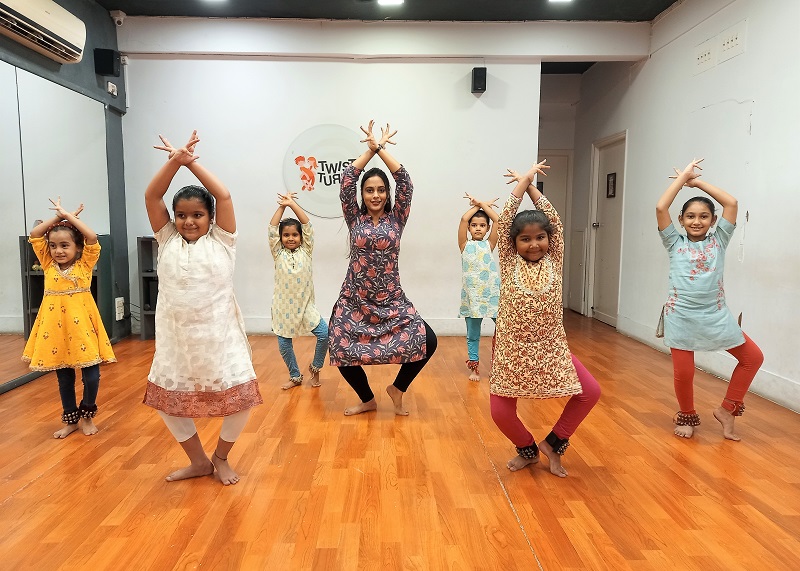
Looking for semi-classical dance classes near me in Kolkata? Semi-classical dance sits at the beautiful intersection of Indian classical discipline and expressive freedom — and the path to mastering it runs through the classical forms. Twist N Turns has been teaching the Indian classical foundation for semi-classical dance in Kolkata since 2005, with Bharatanatyam and Odissi batches running, and Kathak starting in January 2027. Whether your goal is Thumri interpretation, Rabindra Nritya, fusion choreography, or simply the grace and discipline that classical training builds — your journey starts here.
Book a Free Trial Class · Call or WhatsApp 9831018015
What Is Semi-Classical Dance?
Semi-classical dance is the family of Indian dance forms that draw on classical technique — mudras, taal, abhinaya, footwork vocabulary — but are not bound to a single classical canon. Where full classical forms like Bharatanatyam or Kathak operate within a codified system of grammar and aesthetic rules, semi-classical forms use that classical vocabulary more freely: blending it with folk traditions, light classical music, or contemporary movement.
Common semi-classical genres you will encounter:
| Genre | Classical Root | Character |
|---|---|---|
| Thumri-based dance | Kathak | Romantic-devotional, light classical music, expressive abhinaya |
| Rabindra Nritya | Bharatanatyam + Manipuri | Tagore songs and poetry, lyrical, emotionally rich |
| Odissi Fusion | Odissi | Classical structure adapted to folk and devotional themes |
| Dance Drama | Bharatanatyam / Kathak | Narrative storytelling combining classical technique, mime, and expression |
| Bhajan Dance | Kathak / Bharatanatyam | Devotional compositions — Krishna, Radha, Shiva — interpreted expressively |
The key insight: you cannot do semi-classical well without a classical foundation. The mudras must be clean, the taal must be lived in the body, and the abhinaya must come from real training — not imitation.
Why Classical Training Is the Gateway to Semi-Classical Dance
Semi-classical dance is not a simplified version of classical — it is a liberated application of classical vocabulary. Students who attempt semi-classical choreography without classical grounding typically produce movement that looks approximate rather than rooted.
The three classical forms most relevant to semi-classical dance:
Kathak — The Heart of Semi-Classical
Kathak is the classical form most deeply connected to the semi-classical tradition. Its Thumri and Dadra interpretation, Bhajan abhinaya, and expressive face-and-hand vocabulary are the direct ingredients of light classical dance. Kathak-trained dancers have access to the full emotional palette that semi-classical performance demands.
Kathak starts at Twist N Turns in January 2027, planned for all age groups, in the Lucknow and Jaipur gharana traditions. Studios and timings are being finalised — register your interest.
Bharatanatyam — Structure and Precision
Bharatanatyam builds the most precise structural and rhythmic foundation. Its Nritta (pure movement), Nritya (expressive movement), and Natya (dramatic dance) divisions map directly onto the technical, expressive, and narrative dimensions of semi-classical performance.
Active batches at Salt Lake, Dum Dum Park, Ruby, New Alipore, and Rajarhat.
Odissi — Lyrical Grace
Odissi adds a lyrical, flowing quality that translates beautifully into devotional and romantic semi-classical repertoire. Its sculpture-derived postures and sinuous movement quality offer a different aesthetic register from Kathak or Bharatanatyam.
Semi-Classical Dance at 8 Kolkata Studios
Twist N Turns classical and semi-classical pathway batches run across all 8 studios. Call 9830028063 to confirm the nearest open batch and the best form for your goals.
| Studio | Area | Classical Forms Available | Timetable |
|---|---|---|---|
| Salt Lake | Bidhannagar | Bharatanatyam ✅ · Kathak (planned, Jan 2027) | View → |
| Ballygunge | South Kolkata | Bharatanatyam (being planned) · Kathak (planned, Jan 2027) | View → |
| Dum Dum Park | Dum Dum | Bharatanatyam ✅ · Kathak (planned, Jan 2027) | View → |
| Ruby | Kasba / EM Bypass | Bharatanatyam ✅ · Kathak (planned, Jan 2027) | View → |
| New Alipore | South-West Kolkata | Bharatanatyam ✅ · Kathak (planned, Jan 2027) | View → |
| New Town AA1 | New Town | Kathak (planned, Jan 2027) | View → |
| Rajarhat (AA2) | Rajarhat–New Town | Bharatanatyam (being planned) · Kathak (planned, Jan 2027) | View → |
| Madhyamgram | Madhyamgram | Kathak (planned, Jan 2027) | View → |
Kathak studios are still being finalised — see the Kathak page to register interest.
Who Is Semi-Classical Dance For?
Children and teenagers — students who begin classical training young have the deepest semi-classical range by the time they are 12–14. Starting early with Kathak or Bharatanatyam means semi-classical repertoire is natural by the teen years.
Adults who want graceful, expressive movement — semi-classical training is not just for performers. The combination of classical technique and expressive freedom produces a movement quality that many adult students find more satisfying than purely Western forms. You don’t need to perform — the discipline itself is the reward.
Students preparing for competitions and exams — Indian classical and semi-classical dance competitions are held at school, city, state, and national level. A strong classical foundation from Kathak or Bharatanatyam is the differentiator in semi-classical categories.
Cultural performance participants — Puja pandals, school annual days, cultural weeks, wedding sangeet events — semi-classical dance is one of the most universally appreciated performance forms. Training with us gives you a repertoire and a stage-ready standard.
Benefits of Semi-Classical Dance Training
Grace and carriage. Classical training rebuilds posture from the floor up. Within 6 months, students who were desk-bound stand and move differently — visibly.
Expressive range. The abhinaya tradition — learning to communicate joy, sorrow, longing, devotion, surprise through face and gesture — develops emotional range that shows in daily life, not just on stage.
Cognitive depth. Learning taal cycles, mudra vocabularies, compositional structure, and classical theory is a sustained intellectual exercise. It builds memory, concentration, and pattern recognition.
Cultural connection. For many Kolkata families, engaging with Indian classical and semi-classical dance is a way of staying connected to a heritage that is simultaneously ancient and vibrantly alive. Twist N Turns has passed this tradition to over 20,000 students since 2005.
How the Journey Begins
Step 1 — Choose your form. If your priority is expressive abhinaya and light classical music interpretation, start with Kathak. If your priority is structural rigour and precise rhythmic training, start with Bharatanatyam. Not sure? Book a trial in both.
Step 2 — Book a free trial. Every new student gets a free trial class — no commitment, no joining fee. Book here or call 9830028063.
Step 3 — Join the batch. After your trial, join the appropriate beginner batch. The first 8–12 weeks lay the postural and rhythmic foundation that everything else builds on.
Step 4 — Progress through the curriculum. Foundation → Intermediate → Advanced. By Phase 2 (2–3 years in), students are performing semi-classical repertoire at annual concerts and competitions.
Enrolment
Admissions are accepted throughout the year. New terms begin in January, April, July, and October — but a trial class can be booked at any time.
What to bring to your first class:
- One passport-size photograph
- Birth certificate (for minors) or ID (for adults)
- ₹1,770 (₹1,500 + 18% GST) one-time enrolment fee on a 4-week plan (₹885 on a 12-week plan, waived on a 24-week plan); at Madhyamgram ₹500 (no GST)
Book a Free Trial Online · Call or WhatsApp 9831018015
Frequently Asked Questions
What is semi-classical dance?
Semi-classical dance is the broad family of Indian dance that draws on classical vocabulary — mudras, taal, abhinaya, footwork — but is not rigidly bound to a single classical canon. It includes Thumri-based dance, Rabindra Nritya, dance drama, and fusion forms that blend Kathak or Bharatanatyam movement with folk or contemporary elements.
Where can I find semi-classical dance classes near me in Kolkata?
Twist N Turns offers the Indian classical foundation for semi-classical dance in Kolkata, with Kathak starting in January 2027. Call or WhatsApp 9831018015 to confirm the nearest batch.
What is the difference between classical and semi-classical dance?
Classical dance is bound to a codified tradition with fixed technique and aesthetic rules. Semi-classical draws from those traditions but blends them with folk, light classical, or contemporary elements — think of it as classical grammar applied with expressive freedom.
Is Kathak good for learning semi-classical dance?
Kathak is the most natural classical gateway to semi-classical performance. Its Thumri and Dadra tradition, expressive abhinaya vocabulary, and relationship with light classical music makes Kathak-trained dancers the most versatile semi-classical performers.
What age can children start semi-classical dance training?
Children from age 5 can begin the classical foundation work (posture, rhythm, basic mudras, expression) that underpins semi-classical dance. Dedicated semi-classical repertoire is typically introduced around age 8–10.
How long does it take to learn semi-classical dance?
With consistent classes, students present their first semi-classical piece within 1–2 years. Confident solo semi-classical performance usually requires 3–4 years of grounded classical practice. Kathak and Bharatanatyam are the fastest pathways.
What are the best dance forms to learn for semi-classical performance?
Kathak is the most direct pathway — its Thumri tradition sits at the heart of semi-classical dance. Bharatanatyam provides the strongest structural and rhythmic foundation. Bharatanatyam is taught at Twist N Turns, and Kathak starts in January 2027.
Can adults learn semi-classical dance from scratch?
Adult beginners are welcome to enquire. Current Bharatanatyam batches are for ages 6–15, so call 9831018015 to register interest in an adult cohort, and Kathak is planned for all age groups from January 2027. Most adults develop enough classical foundation to explore semi-classical repertoire within 18–24 months. Batches are timed around working hours.
What is Rabindra Nritya?
Rabindra Nritya is the dance tradition rooted in Tagore’s songs and poetry, blending Bharatanatyam and Manipuri movements with Bengal’s folk aesthetics. It is one of Kolkata’s most cherished semi-classical traditions. A Bharatanatyam or Kathak foundation makes Rabindra Nritya significantly more accessible.
How do I book a trial class for semi-classical dance training?
Book online at our free trial page, or call or WhatsApp 9831018015. Mention your interest in semi-classical dance or the specific form (Kathak, Bharatanatyam) and your preferred studio — the team will match you with the right batch.
What is Thumri-based dance?
Thumri is a light classical music form of North India built on romantic-devotional themes. Thumri-based dance interprets this music through Kathak’s expressive abhinaya vocabulary — it is the most widely performed semi-classical genre in North and East India, and Kathak training is its direct pathway.
Is Bharatanatyam a semi-classical dance form?
Bharatanatyam is a full classical dance form — one of eight officially recognised classical forms in India. However, Bharatanatyam techniques are directly applicable to semi-classical performance, and many semi-classical productions use Bharatanatyam-trained performers for their technical precision and expressive range.
Start Your Semi-Classical Journey — Book a Free Trial
The path to semi-classical dance runs through classical training — and Twist N Turns has been building that foundation in Kolkata for over 20 years. Kids from age 5, teenagers, adults — small batches, trained gurus, and a programme that builds technique you keep for life.
Call or WhatsApp 9831018015, or email info@twistnturns.in.