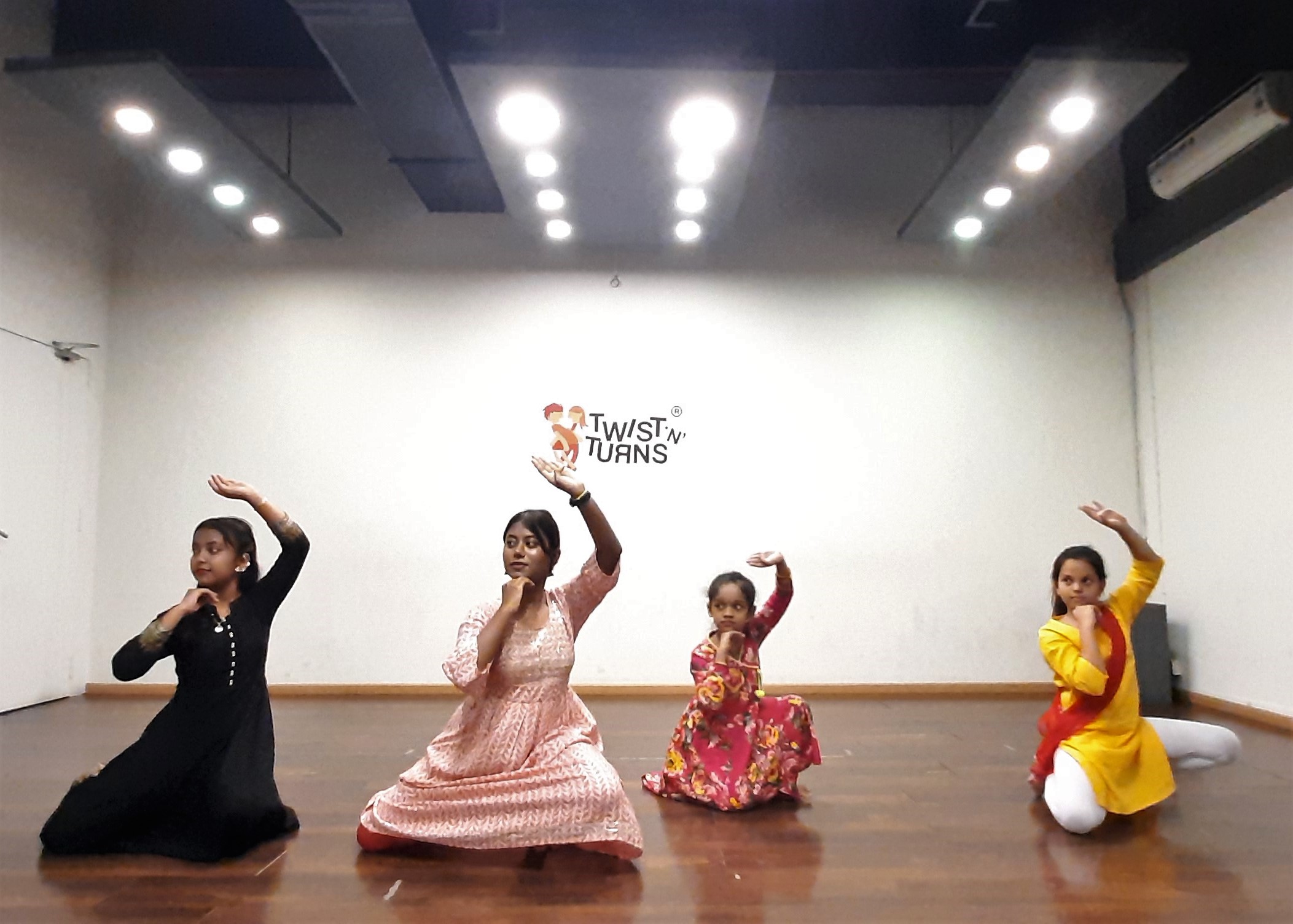
Searching for kathak classes near me in Kolkata? Twist N Turns is launching guru-led Kathak training in Kolkata from January 2027 — teaching both the Lucknow and Jaipur gharana traditions to children from age 5, teenagers, and adults at every level. Teaching dance in the city since 2005, we have built a programme that combines uncompromising classical grammar with warm, modern teaching.
Register Interest — Kathak Starts January 2027 · Call or WhatsApp 9831018015
Kathak Classes Near Me in Kolkata — Why Twist N Turns
Kolkata has always been a classical city — but Kathak, despite being the only Indian classical form native to the North, has historically been under-served here. We built our programme to change that: Kathak classes near me at Twist N Turns are taught by senior gurus in the Lucknow and Jaipur traditions, with cohorts forming at our Kolkata studios as demand builds.
Posture you keep for life. Kathak’s fundamental Angas stance aligns spine, neck, shoulders, and hips. Within six months, students stand visibly straighter.
A workout hidden inside art. Tatkaar footwork — the hallmark of Kathak — is cardio, calf-conditioning, and ankle-strengthening rolled into one. Chakkars (spins) build core stability like nothing else.
Cognitive sharpness. Learning taal cycles, mudra vocabularies, and compositional structure is a weekly workout for memory and pattern recognition.
Stage presence and confidence. Bhav work and annual performances translate directly into public-speaking presence and emotional range — visible off the dance floor.
The gateway to semi-classical dance. Kathak is the most direct classical foundation for semi-classical dance performance — its Thumri and Bhajan tradition is the heart of light classical and fusion repertoire.
Kathak Starts January 2027 — Register Your Interest
We are launching Kathak at Twist N Turns from January 2027, planned for all age groups — children, teenagers and adults — wherever we can form a batch. Studios, days and timings are still being finalised, so nothing is fixed yet.
- Register interest now and we will tell you first, taking your preferred studio, day and age group into account. Use the free trial form (mention Kathak) or WhatsApp 9831018015.
- Fees are our standard slabs — the same as every other class (see Enrolment below).
- The trial class is free once your batch is confirmed.
How Kathak Batches Work — and How to Join the Next One
Kathak cohorts form at a studio when a minimum group is confirmed, so availability changes from month to month. The simplest way to find your batch:
- Check the live schedule at the bottom of this page — any running Kathak batch appears there automatically, with its studio, timing and level.
- If nothing is listed near you, WhatsApp 9831018015 with your preferred studio, day and age group. We will confirm the nearest batch, or add you to the next cohort and notify you when it opens.
- Book a trial class once a batch is confirmed — the class itself is free.
Not sure which studio is closest? Use the studio finder or browse the studio locations.
The Four Pillars of Kathak Training
Every Kathak student at Twist N Turns is built up through four interlocking fundamentals.
Angas — Posture
Kathak begins in the body, not the feet. The Angas — the basic standing stance — aligns the head, neck, spine, hips, and legs into a single line. Everything else in the form is built on this posture. You cannot spin cleanly, hit tatkaar cleanly, or hold abhinaya cleanly without it.
Mudras — Hand Gestures
Kathak uses roughly sixty named mudras, divided into two families: asamyukta (single-hand) and samyukta (two-handed) gestures. Mudras are the dancer’s vocabulary. A story can pivot on a single hand shape, and clean mudras separate a trained Kathak dancer immediately.
Tatkaar — Footwork
Tatkaar is the rhythmic strike of the foot against the floor, set to the beat. Basic tatkaar is practised in teentaal (16 beats) and worked through a ladder of speeds — vilambit (slow), madhya (medium), drut (fast). Beginners drill tatkaar daily before layering chakkars, tukras, and parans on top.
Bhav — Facial Expression
Classically called Mukhaj Abhinaya, this is the expressive face work that carries the story. Joy, sorrow, fear, devotion, anger, surprise — the nine navarasas are the emotional palette a Kathak dancer must command.
Lucknow and Jaipur — The Two Gharanas
Our gurus teach the two most widely practised gharanas:
- Lucknow gharana — grace, abhinaya, romantic-devotional themes, softer line. Emphasises the lyrical, expressive dimension of the form.
- Jaipur gharana — powerful tatkaar, tayari (technical virtuosity), sharper line. Emphasises rhythmic precision and physical force.
Beginners learn foundations common to both. Intermediate and advanced students can specialise as their own strengths emerge. This dual-foundation approach is deliberately modern — classical scholars will appreciate that our gurus do not insist on single-gharana purity at beginner stage.
Our Kathak Curriculum — Three Progressive Phases
Phase 1 — Foundation (6–12 months)
- Angas — the five fundamental standing postures
- Tatkaar — basic footwork syllables (Ta-Thei-Thei-Tat)
- Teentaal — 16-beat cycle recognition and clap exercises
- Mudras — foundational Asamyukta and Samyukta gestures
- Chakkar introduction — first spins with proper head-spotting
Phase 2 — Intermediate Repertoire (2–3 years)
- Tukras, Tihais, and Parans — short rhythmic compositions
- Gat-Nikas — walking patterns depicting characters
- Abhinaya introduction — expressive storytelling
- Multiple taal families — ektaal, jhaptaal, dhamar
- Ghungroo practice — 100-bell to 200-bell progression
Phase 3 — Advanced and Solo (5+ years)
- Full solo repertoire — vandana, thaat, aamad, paran, gat-bhaav, tarana
- Kavit and Bhajan interpretation
- Stage performance at annual concert
- Examination track — for students pursuing formal classical certification
Who Can Learn Kathak?
Children from age 5 — pre-classical introduction: rhythm, posture, play-based learning. Formal syllabus-based training begins at 7–8.
Teenagers — the technical rigour of Kathak suits teens who want measurable progress. The depth of bhav gives them an artistic outlet few other activities can match.
Adults and working professionals — adult beginners progress with surprising speed, because focus and emotional maturity compensate for any physical stiffness. We run dedicated adult batches timed around professional schedules.
Aspiring semi-classical performers — if your goal is semi-classical dance, Thumri interpretation, or fusion choreography, Kathak is your ideal starting point. The expressive and rhythmic vocabulary you build here transfers directly to semi-classical repertoire.
What to Expect in Your First Kathak Class
Minutes 0–10 — Pranam and warm-up. Students greet the guru. Gentle ankle, calf, and spine mobility.
Minutes 10–25 — Angas and tatkaar. Basic standing posture, first footwork syllables with voice recitation (bol-padhant).
Minutes 25–45 — Taal and mudras. Clapping out teentaal’s 16-beat cycle, learning 4–5 foundational mudras.
Minutes 45–60 — Short composition and cool-down. A simple 8-beat sequence set to recorded accompaniment. No performance expected — just feel and rhythm.
Live Schedule
Current batch timings are shown below, pulled live from our studio sheet. If no batches are listed yet, Kathak is still being scheduled for January 2027 — WhatsApp 9831018015 to register interest and we will notify you when slots open.
Enrolment
Admissions are accepted throughout the year. New terms begin formally in January, April, July, and October — but a trial class can be booked at any time.
What to bring:
- One passport-size photograph
- Birth certificate (for minors) or ID (for adults)
- ₹1,770 (₹1,500 + 18% GST) one-time enrolment fee on a 4-week plan (₹885 on a 12-week plan, waived on a 24-week plan). Madhyamgram has its own fees: ₹1,200 for one class a week or ₹2,000 for two classes a week, every 4 weeks, in 4-week packages only (no 12- or 24-week plans), plus a one-time enrolment fee of ₹500. No GST is charged at Madhyamgram.
Try before you enrol. The trial class is free; a ₹100 booking fee confirms your slot and is adjusted against your first month’s fees. Book online here, or call or WhatsApp us your preferred studio and time.
Frequently Asked Questions
Where can I find Kathak classes near me in Kolkata?
Kathak at Twist N Turns starts from January 2027. Studios, days and timings are still being finalised, and we are planning batches for all age groups. Once a batch is confirmed it appears in the live schedule on this page. To be told first, register interest at twistnturns.in/free-trial.html or call or WhatsApp 9831018015 with your preferred studio, day and age group.
When do Kathak classes start at Twist N Turns?
From January 2027. The exact studios, days and times are not fixed yet — register interest and we will confirm them with you first. The trial class is free once your batch is confirmed.
What is the right age to start Kathak?
Children from age 5 can start with basic tatkaar and rhythm games. Formal syllabus-based training typically begins at 7–8. Adults can begin at any age — we run dedicated beginner batches for teens and adults starting from scratch.
Which gharana of Kathak do you teach?
Our gurus teach primarily in the Lucknow and Jaipur gharana traditions — Lucknow emphasises grace, abhinaya, and subtle expression, while Jaipur focuses on crisp footwork, tayari, and powerful rhythmic patterns. Students learn foundations of both before specialising.
How long does it take to learn Kathak?
Kathak is a lifelong discipline. Basic tatkaar and simple compositions take 6–12 months. Intermediate repertoire — tukras, parans, basic gat-nikas — takes 2–3 years. Full command, solo-recital-ready, is typically a 7–10 year journey.
Do I need ghungroos to start?
Not for your first few classes. We’ll let you know when you’re ready to practise with ghungroos — usually after tatkaar basics stabilise. Our gurus can advise on the right pair.
What is taught in the first Kathak lesson?
You’ll learn Angas (basic posture), the 16-beat teentaal cycle, first steps of tatkaar with voice recitation, and 4–5 foundational mudras. No performance expected — just feel and rhythm.
Is Kathak good for kids?
Yes — Kathak builds posture, rhythm, concentration, memory, and confidence. The footwork and rhythm patterns are strong cognitive training; the storytelling element develops expression and stage presence. Kids’ cohorts follow an age-appropriate syllabus progression.
Is Kathak suitable for working adults?
Absolutely. Our adult beginner cohorts welcome students in their 20s, 30s, 40s and beyond. Kathak improves posture, flexibility, memory, and focus — particularly rewarding for desk-bound professionals. We try to time adult cohorts around working hours.
What should I wear to a Kathak class?
A churidar-kurta or loose cotton salwar is ideal. Avoid tight jeans or restrictive clothing. Practice is barefoot — no shoes needed for beginners.
What are the Kathak class fees?
Standard fees are charged every 4 weeks and depend on how many days a week you attend: ₹1,999 for once a week, ₹2,999 for twice a week and ₹3,499 for three times a week, plus a one-time enrolment fee of ₹1,770 (₹1,500 + 18% GST) (₹885 on a 12-week plan, waived on 24 weeks). The trial class is free; a ₹100 booking fee confirms your slot and is adjusted against your first month’s fees. Call 9831018015 to confirm the exact amount for Kathak at your studio. See the fee calculator for plan options. Madhyamgram has its own fees: ₹1,200 for one class a week or ₹2,000 for two classes a week, every 4 weeks, in 4-week packages only (no 12- or 24-week plans), plus a one-time enrolment fee of ₹500. No GST is charged at Madhyamgram.
How do I book a trial class?
Kathak batches start from January 2027, so register your interest here now, or call or WhatsApp 9831018015. Mention Kathak and your preferred studio — once your batch is confirmed, the trial class is free and the team will place you in the right group.
Do you hold annual performances?
Yes. Senior Kathak students perform at the Twist N Turns annual concert and at select cultural events through the year. Stage time is part of the curriculum, not an add-on.
Can complete beginners join without prior dance experience?
Absolutely. Our beginner batches assume zero prior experience. The first 8–12 weeks build fundamental body awareness, basic posture, and simple footwork patterns. Many of our most dedicated students started as complete beginners.
Is Kathak a semi-classical or classical dance form?
Kathak is one of the eight officially recognised Indian classical dance forms. However, its deep connection to Thumri, Dadra, and Bhajan interpretation makes Kathak training the most natural gateway to semi-classical dance performance. Many of India’s finest semi-classical performers have a Kathak foundation.
Start Learning — Register Your Interest
Kathak in Kolkata, taught by trained gurus in the Lucknow and Jaipur traditions. Kids from age 5, teenagers, adults, all levels — in small batches where your teacher’s eye is always on your posture and progress.
Call or WhatsApp 9831018015, or email info@twistnturns.in.
Explore More
- Semi-Classical Dance Classes in Kolkata
- Bharatanatyam Classes in Kolkata
- Odissi Dance Classes in Kolkata
- Kids Dance Classes Kolkata
- Adult Dance Classes in Kolkata
- All Indian Classical Dance Forms
- Full Class Timetable
- Book a Free Trial
Current Class Schedule
Current schedule for this class is being updated. Call or WhatsApp 9831018015 for today's available batches.