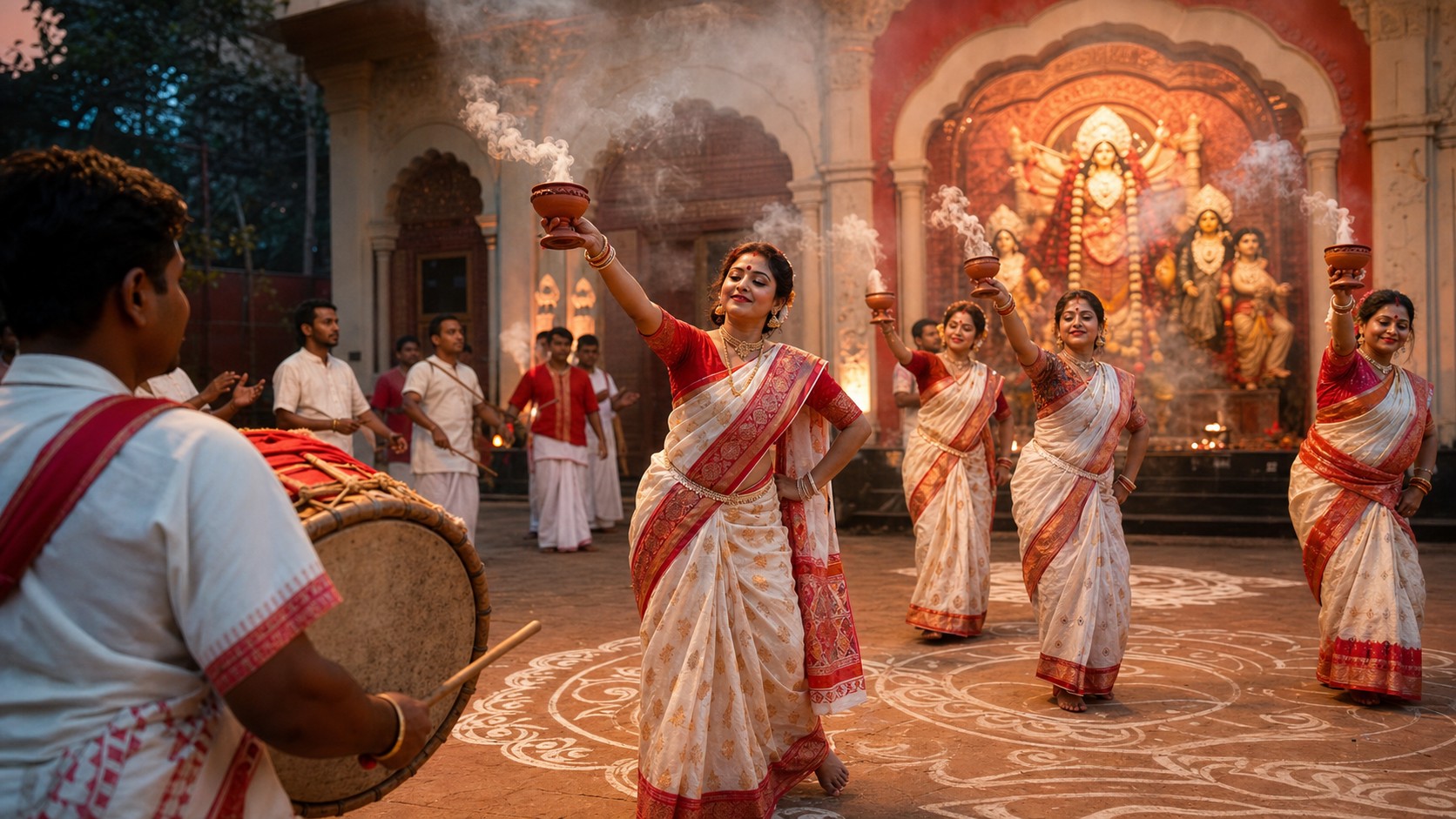
Dhunuchi Naach Step by Step for Durga Puja
Dhunuchi Naach is one of the most recognisable sights of Durga Puja: the beat of the dhak rises, incense smoke curls through the pandal, and dancers move with a clay or metal dhunuchi in their hands.
It looks spontaneous from outside. Good Dhunuchi Naach is not random, though. It has rhythm, posture, breath, control, and a deep sense of offering. If you are a beginner, the safest way to learn it is to separate the dance into simple layers before you ever handle smoke or heat.
This guide gives you a step-by-step beginner structure for learning Dhunuchi Naach for Durga Puja, school cultural programmes, para pandals, family functions, and stage-friendly Bengali cultural performances.
For help creating a Puja performance, call or WhatsApp 9831018015 or book a free trial class.
What Dhunuchi Naach Means
“Dhunuchi” is the incense burner. “Naach” means dance. During Durga Puja, the dhunuchi is traditionally used in aarti, often with coconut husk, incense, and camphor creating thick fragrant smoke.
The dance is devotional first. The steps should feel energetic, but never careless. The dancer is not just showing tricks with a prop; the dancer is responding to the dhak and offering movement inside a Puja atmosphere.
Durga Puja in Kolkata was inscribed on UNESCO’s Representative List of the Intangible Cultural Heritage of Humanity in 2021. UNESCO describes the festival through its public art, clay images, drumming, installations, and collective cultural participation. Dhunuchi Naach lives inside that same living Puja ecosystem. Source: UNESCO Durga Puja in Kolkata archive.
Related cultural page: Roots of Bengal cultural dance experience
Safety First: Learn Empty Before Smoke
Before the steps, set the rule:
Do not start with fire, smoke, or burning material. Start with an empty prop.
For beginners, use:
- An empty clay dhunuchi.
- A lightweight metal bowl.
- A covered cup or safe practice prop.
- A cloth bundle only for hand-pathway practice.
Do not use burning coconut husk, camphor, incense, or smoke until the dancer is confident with balance and the organiser has approved the space.
Basic safety checklist:
| Safety item | Why it matters |
|---|---|
| Open space | Arms, smoke, and turns need room. |
| Cotton-friendly costume | Avoid loose synthetic fabric near heat. |
| Hair tied back | Hair should not fall toward the prop. |
| Adult supervision | Required for any real dhunuchi practice. |
| No crowding | Pandal energy is high; spacing must be planned. |
| Wet cloth / extinguisher nearby | Only for supervised real-prop rehearsals. |
If this is for a child or school group, keep it prop-only unless the event safety team takes full responsibility for a controlled ritual setup.
Step 1: Find the Dhak Pulse
Dhunuchi Naach starts with the dhak. Do not rush into hand movements.
Stand with feet hip-width apart. Keep the knees soft. Listen for the repeating pulse and count:
1 - 2 - 3 - 4 / 1 - 2 - 3 - 4
Begin with a simple bounce:
- Bend both knees slightly on count 1.
- Rise gently on count 2.
- Bend again on count 3.
- Rise on count 4.
Repeat for 8 sets. Your shoulders should not jump wildly. The movement comes from the knees, ankles, and breath.
Beginner mistake: dancing only with the arms. Dhunuchi Naach needs the whole body to ride the dhak.
Step 2: Learn the Basic Step-Tap
Once you can hear the rhythm, add footwork.
Use this pattern:
| Count | Action |
|---|---|
| 1 | Step right foot to the side |
| 2 | Tap left foot near right |
| 3 | Step left foot to the side |
| 4 | Tap right foot near left |
Keep the knees soft. Let the torso sway naturally from side to side. Practise this without a prop until you can do it for one full minute without looking at your feet.
Then add direction:
- 4 counts facing front.
- 4 counts turning slightly right.
- 4 counts facing front again.
- 4 counts turning slightly left.
This is the base for most beginner Dhunuchi movement.
Step 3: Add the Forward-Back Walk
For pandal performance, you need to move through space without losing rhythm.
Try:
| Count | Action |
|---|---|
| 1 | Step forward right |
| 2 | Step forward left |
| 3 | Step back right |
| 4 | Step back left |
Keep the prop imaginary at chest level. Do not swing the arms yet. The aim is to make your feet reliable.
Practice tip: put a line of tape on the floor. Move forward and back on that line so you do not drift into other dancers.
Step 4: Hold the Dhunuchi Correctly
Start with an empty prop.
For one dhunuchi:
- Hold it from the stem or base, depending on the shape.
- Keep wrist firm but not locked.
- Keep the bowl slightly away from the body.
- Keep elbow soft, not straight and stiff.
For two dhunuchis:
- Practise with empty props only.
- Keep both hands at equal height first.
- Avoid crossing arms until your basic balance is strong.
- Never try mouth-held dhunuchi tricks as a beginner.
If your wrist shakes, reduce the movement size. Control matters more than drama.
Step 5: Add the Three Hand Levels
Most beginner routines can be built from three levels:
| Level | Position | Use |
|---|---|---|
| Low | Near waist | Calm entry, slow rhythm |
| Middle | Chest level | Main step-tap phrase |
| High | Shoulder to head level | Build energy for chorus or dhak peak |
Practise this sequence:
- 8 counts low.
- 8 counts middle.
- 8 counts high.
- 8 counts back to middle.
Keep the prop upright. Do not tilt it sharply in practice. If you later use smoke, tilting without control is dangerous.
Step 6: Add the Half-Turn
Do not spin first. Learn a half-turn.
Pattern:
- Step right.
- Tap left.
- Turn half-way to your right.
- Tap and settle.
Repeat to return front.
Keep the knees bent and eyes level. If you feel dizzy, reduce the turn and practise spotting one fixed point in the room.
Step 7: Build a 60-Second Beginner Routine
Here is a simple structure for a first performance:
| Section | Counts | Movement |
|---|---|---|
| Entry | 16 | Slow walk in, dhunuchi low |
| Base rhythm | 32 | Step-tap side to side, middle level |
| Travel | 16 | Forward-back walk |
| Energy lift | 32 | Hand level low-middle-high-middle |
| Turn phrase | 16 | Half-turn right, half-turn left |
| Group circle | 32 | Circle walk with safe spacing |
| Ending | 16 | Face the idol/audience, hold strong final pose |
This is enough for a beginner pandal moment. Once clean, you can add group formations, call-and-response, and sharper dhak accents.
For school or cultural-event choreography help, see corporate and group performance options or wedding and sangeet choreography if the performance is part of a family function.
Group Formations for Pandal or Stage
Dhunuchi Naach becomes stronger when the group is clean.
Use beginner-safe formations:
- Single line: best for school stages and narrow spaces.
- Semi-circle: best when facing an idol or central audience.
- Two diagonals: good for 6-10 dancers.
- Outer circle: works only if the floor is spacious and dry.
Avoid complex crossings with props unless dancers are trained. In a Puja crowd, a simple formation performed confidently is better than a risky pattern.
Costume and Prop Tips
For women, a sari can look beautiful, but it must be pinned securely. For men, dhoti-kurta or kurta-pajama can work if the lower garment is tied properly. For children, choose movement-safe traditional outfits over heavy styling.
Checklist:
- Secure pins and pleats.
- No loose dupatta near the prop.
- No dangling sleeves.
- No slippery footwear.
- Hair tied back.
- Practice once in costume before performance day.
If you are adapting the dance for a stage show, you can use non-burning theatrical props and lighting instead of live smoke.
Common Beginner Mistakes
Mistake 1: Starting with the real dhunuchi too early Learn footwork and hand pathways first.
Mistake 2: Holding the prop too close to the face Keep the prop away from your body line.
Mistake 3: Dancing faster than the dhak The dhak should guide you. Do not outrun it.
Mistake 4: Over-spinning Half-turns are enough for beginners.
Mistake 5: No spacing Dhunuchi Naach needs room. Plan entries, exits, and emergency stop points.
How to Practise Over 7 Days
| Day | Practice focus |
|---|---|
| Day 1 | Listen to dhak rhythm, practise bounce and step-tap |
| Day 2 | Add forward-back walk and side travel |
| Day 3 | Practise empty-prop grip and three hand levels |
| Day 4 | Add half-turns and clean final pose |
| Day 5 | Build the 60-second routine |
| Day 6 | Rehearse in costume or costume-like clothing |
| Day 7 | Run full routine with spacing and safety checklist |
If you have a group, record the Day 5 and Day 6 runs. Most spacing problems become obvious on video.
Can Twist N Turns Help With Dhunuchi Naach?
Yes. Twist N Turns can help with:
- Beginner Dhunuchi movement training.
- Durga Puja cultural performance planning.
- School or para group choreography.
- Stage-safe prop adaptations.
- Bengali folk and cultural dance presentation.
- Confidence and rhythm training through regular dance classes.
If you want this for a Puja event, call early. The best time to prepare is before the final pandal rush.
Start with Twist N Turns studio locations, transparent class fees, or book a free trial.
Related reading: Annual Day choreography songs and planning, Bollywood dance classes in Kolkata, and dance classes near you in Kolkata.
Final Word
Dhunuchi Naach is powerful because it is not only a dance. It is rhythm, devotion, community, and Puja atmosphere in motion.
Learn it with respect. Practise it safely. Keep the steps simple until your rhythm is steady. When the dhak begins and the smoke rises, the best dancer is not the one doing the biggest trick. It is the one who can hold the feeling of Puja and move with control.
For Dhunuchi Naach training or Puja choreography support, call or WhatsApp 9831018015.