Why children respond so well to movement-based fitness — and how Twist N Turns’ Kids Yoga and Zumba programme has evolved from a 2020 lockdown response into a permanent part of our kids’ calendar.
Why Kids and Movement Belong Together
Children are built to move. Long periods of sitting — whether at school, on screens, or through extended indoor stretches like the 2020 lockdowns — push against their nature, and parents see the result: restlessness, mood swings, poor sleep, slumped posture.
Yoga and Zumba solve different parts of the same problem. Zumba gives kids a structured, joyful way to burn energy to music with their peers. Yoga gives them breath, focus, and the ability to sit still on purpose. Taught together across the week, they cover almost the full range of what a child’s body and mind need.
How the Kids’ Programme Started at Twist N Turns
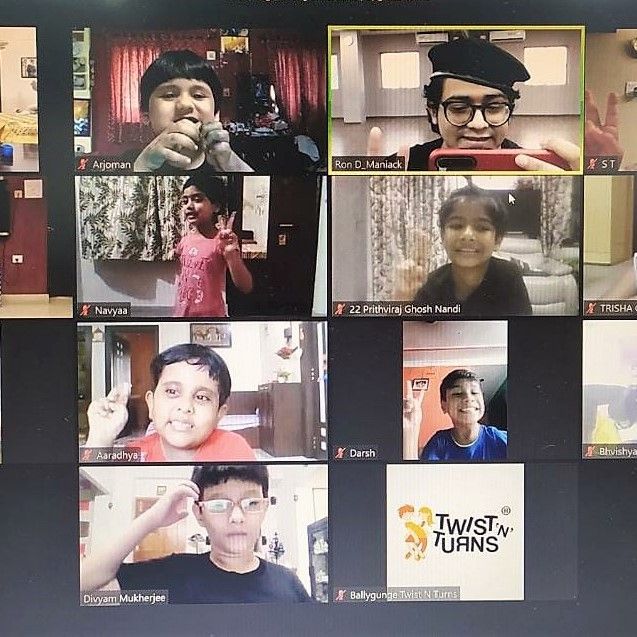
Twist N Turns launched its first online Kids Zumba batches on 2 June 2020, a response to the lockdown months when children were stuck indoors with nowhere to channel their energy. Founder Tapash Das described the thinking at the time:
“Many kids are cooped up indoors with a lot of pent-up energy that needs to be released. Engaging in some physical exercise is a great way to channel that energy positively. It benefits both children and parents. Children absolutely love dancing to vibrant music with their peers. It’s a fun activity that also has numerous advantages — Zumba helps develop hand-eye coordination, enhances flexibility, and boosts self-confidence.”
The response to those first batches was strong enough that the programme didn’t end when studios reopened — it simply added in-person batches alongside the online ones. Online classes still run today for families who prefer home delivery or live outside Kolkata.
Kids Zumba — the Format
Our kids’ Zumba is taught by certified instructors trained to adapt the standard Zumba format for children:
- Age-split batches — ages 3.5–6, 7–10, 11–13 so music, pace and complexity match the group.
- Short, high-variety segments — kids don’t sit in one song for four minutes; tracks and themes switch to hold attention.
- No weight-loss framing — the goal is active, happy, coordinated movement. Conditioning happens as a side-effect.
- Performance arcs — senior kids’ batches work toward on-stage moments at studio showcases.
The underlying principle, as one of our kids’ Zumba instructors put it: “Instead of keeping kids stationary, parents should realise how beneficial it is for them to move around actively. Our focus is not on weight loss but on making children active and happy. We encourage them to dance without imposing strict routines.”
Kids Yoga — the Format
Kids’ yoga at Twist N Turns is not a scaled-down adult yoga class. It’s built differently:
- Story-led classes — children learn asanas through narratives (the caterpillar stretch, the mountain pose as a giant, the tree pose as a forest). A favourite early reference was adapting Eric Carle’s “The Very Hungry Caterpillar” into a full sequence.
- Pranayama without the label — breath work is taught through games, not jargon. Kids learn it without realising it’s “yoga”.
- No advanced inversions — headstands and handstands are deliberately excluded for safety, especially in online settings.
- Short, varied sessions — attention spans dictate the structure, not adult class timing.
The aim is not asana perfection. It’s familiarity — so that when these children become teenagers and adults, yoga already feels natural rather than intimidating.
What Parents Actually Notice
After a term of regular Yoga or Zumba, the feedback pattern is remarkably consistent:
| Area | What changes |
|---|---|
| Mood | Calmer after class; less screen-time irritability |
| Sleep | Easier to wind down, especially after a Zumba day |
| Posture | Straighter sitting, fewer “slumped shoulder” complaints |
| Focus | Better concentration on homework and reading |
| Confidence | Visible pride in performing / demonstrating for family |
| Social | Friendships formed with batch-mates across schools |
Why Both, Not Just One
Parents often ask whether to pick Yoga or Zumba. The honest answer: pick both if the schedule allows — they cover different gaps.
| Zumba | Yoga | |
|---|---|---|
| Primary benefit | Cardio, coordination, rhythm | Focus, flexibility, breath |
| Social mode | High-energy group | Quieter group or solo |
| Best after | A sedentary school day | A high-stress or screen-heavy day |
| Builds toward | Performance, dance forms | Lifelong mind-body habit |
| Typical intensity | High | Low–medium |
Two sessions a week — one of each — is a common and effective split.
Encouraging Your Child to Stick With It
Some practical notes from years of running these batches:
- Show up with them, not at them. Kids pick up enthusiasm from parents. If you treat the class as important, they do too.
- Don’t miss the first four weeks. That’s when batch friendships form. A child who bonds with peers in week 3 rarely wants to drop out in week 8.
- Let them show you. Ask them to teach you one asana or one Zumba step at home. Ownership builds engagement.
- Don’t force perfection. Especially in yoga — the habit matters more than the pose.
- Celebrate showcase moments. The annual studio shows are when months of class turn into a real stage memory.
Book a Trial
- Book a free trial: /free-trial.html — pick Kids Yoga or Kids Zumba and your nearest studio.
- Kids dance programme overview: Kids dance classes at Twist N Turns
- Creative Movement (ages 3–5): /classes-forms/creative-movement-kids-3-5-to-5yrs.html
- Zumba classes — general: /classes-forms/fitness/zumba-classes-kolkata.html
- Full studio timetable: /locations.html
Get In Touch
- Call / WhatsApp: 98310 18015
- Email: info@twistnturns.in
- All studios (Kolkata): /studios.html
Twist N Turns — teaching dance and fitness in Kolkata since 2005.